
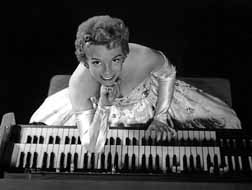
Famous Organists: Ethel Smith

For over 100 years, Viscount Organs has been producing organs of unparalleled quality. In that time, countless musicians have sat behind the pedals and keys of our organs and played everything from timid first notes to entire concertos. We’re glad that we’ve been a part of the music community for so long, and we’re always happy to recognize the musicians who have had truly spectacular careers.

Our second installment of our Famous Organists series will look at the career of the incredible Ethel Smith. Ethel was an accomplished musician in every sense of the word, and her contributions to the world of organ playing cannot be understated.

From Humble Beginnings

Little is known about Ethel Smith’s early years. Although she often stated that she was born in 1910, records show she was actually born in 1902. She grew up in Pittsburgh, Pennsylvania, where her parents, Max and Elizabeth, encouraged her interests and supported her ambitions. From an early age, she pursued three lifelong passions: golf, music, and languages.

Ethel began her golf career at just 16 years old, playing regularly on courses throughout Pittsburgh. Soon after, she studied languages at the Carnegie Institute of Technology, where she became fluent in German, French, and Spanish. At the same time, she studied organ with Dr. Caspar Koch, the city organist of Pittsburgh and a respected author of organ and music pedagogy.

After completing her studies, Ethel sought work in the performing arts and accepted a position as a pianist with a local theater group. Her career soon took a dramatic turn when a traveling Shubert production of Romberg’s The Student Prince stopped in Pittsburgh. The show’s manager quickly recognized her talent and invited her to join the tour, which lasted 28 weeks. The production traveled across the country and eventually brought her to California.

It was there that Ethel’s organ career began its rise to stardom. In 1935, while working on a Hollywood studio lot, she was asked if she could play the newly developed Hammond electric organ. Although she had never performed on an electric organ before, she visited a nearby Hammond showroom to practice on the floor models. She later recalled in a New York Times interview, “I just ran my fingers over it and said, ‘That’s for me!’” As she practiced, she gave informal performances that drew growing crowds eager to hear the new instrument.

The Start Of Something

Hammond recognized that they had a star in their midst, and quickly offered a 26-week engagement to play their new instrument at the famed Copacabana Club in Rio de Janeiro, Brazil. She spent nearly a year there, immersing herself in the local culture, and exploring the unique sounds of Latin music.

Her time in Brazil proved invaluable. While visiting a rough part in Rio, Ethel stopped to listen to a local dancehall group perform an unfamiliar tune. The musicians played a traditional Argentine melody, though neither the composer nor the title was known. Ethel adopted the tune, named it “Tico Tico,” and added it to her performances. The piece quickly became a favorite with audiences.

The Japanese attack on Pearl Harbor in late 1941 brought Ethel back to the United States. Soon after, she received an invitation to perform on the popular radio program Your Hit Parade. Thanks to her talent and engaging personality, she became the highest-paid performer on the show. Her success on radio launched her recording career, and in 1944 she recorded “Tico Tico.” The song became an overnight sensation, selling more than one million copies and ranking among the best-selling records of the 1940s.

Beyond her achievements as an organist, Ethel also found success as an actress. She made her film debut in Bathing Beauty in 1944 and appeared in additional films throughout 1945 and 1946, performing alongside some of Hollywood’s biggest stars.

A Performer To The End

Ethel Smith was born to be a musician and performer. She played in shows, and performances, and starred in films well into her 80s. She would appear in non-musical roles on Broadway, and toured throughout the 1950s and 1960s, riding on the success of “Tico Tico.” Ethel Smith would live to be 94 years old and was active in making music for nearly all of it. She became known as the “Empress of Hammond” for her titanic organ playing career, and near-exclusive use of Hammond’s electric organs. She made organ music accessible and fun for generations of audiences, and introduced new genres of music to American listeners.

Viscount Organs

When you’re ready to experience that same joy and excitement, explore what Viscount Organs has to offer. Our Legend digital organs capture the iconic electric organ sound that Ethel Smith made famous. Contact Viscount Organs today to learn more.

Share the post: